
I’ve been doing some ancestry research lately. I love poring over marriage certificates, death notices, and census records. I imagine those census takers knocking on doors, asking who lives there, taking a stab at how to spell the last name. I wonder if they realized their handwritten notes would be inspected by someone sitting in front of a screen 150 years later. How could I even explain my job to them?
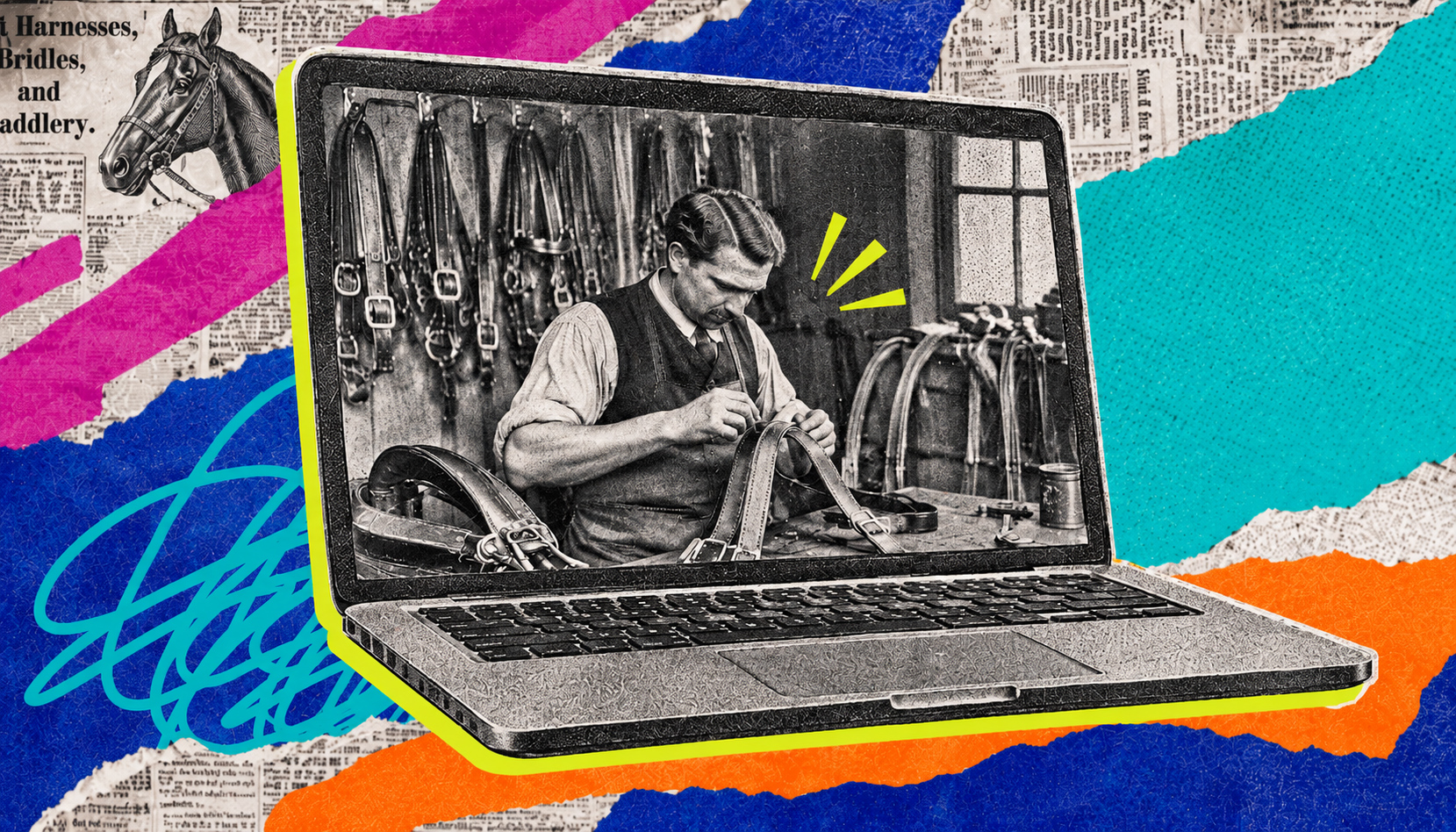
Almost every ancestor in my line traces back to Germany or Ireland, and most came over in the late 19th century. One has his job listed as “saddle maker.” I did a little research to understand why a saddle maker would move from Germany to New York City in 1882. Every life is unique, but we’re all caught up in the movements of the moment. In Germany, the pressure was a mix of shrinking farmland, industrialization, and political oppression. So Valentin and Magdalena made the ocean crossing at age 24 to start a new life in Brooklyn. And here I am.
Uncovering the occupations in my line (harness maker, tinsmith, carpenter, grocer, furniture dealer) makes me wonder where my own work fits in the historical stream. My job has ranged from graphic designer to web designer to creative director to communications consultant. I think it all comes down to communication.
Post-Gutenberg, it’s not hard to imagine what my work would have looked like. Maybe I would have been a town crier, or inked the plates on a printing press. Going back further, would I have been a scribe? A cave painter? For as far back as we can see, humans have communicated visually as well as verbally, leaving messages for one another and making meaning of their experiences through images and words.
Now we’re in a strange new era where information is so plentiful we’re almost drowning in it. Paying for information seems almost ridiculous. I want to pay someone to take away the onslaught of content!
But communication isn’t just information. It’s how we figure out what we think, together. Even one-to-many communication is a two-way street. When I work with social impact organizations, a big part of my job is asking what their audiences need and value, and actually listening to the answers.
Context matters too. The town crier could look into the eyes of the crowd and sense its mood. (Note that I know absolutely nothing about town criers, other than this tidbit from a modern-day one: “In Goslar, Germany, a crier was employed to remind the local populace not to urinate or defecate in the river the day before water was drawn for brewing beer.” Ok friends in public health, you can trace your roots back to the town crier too!)
Today’s audiences are drinking from a firehose of content. So whenever I’m helping a client create something, whether it’s a digital impact report, a website, or a printed one-pager that might end up on someone’s desk, I’m thinking about the human who will encounter it. Everything from their values to their need for delight to their increasingly short attention span.
The details change, but we haven’t changed all that much since our ancestors painted on cave walls.
So if I’m back at that door with the census taker, standing next to my saddle-maker ancestor, here’s what I’d say: I help communities get their message to the people who need to hear it, in a way that makes them want to learn more. I hope he’d understand. A saddle has to fit the rider, too.
If you’re working on something that needs to reach people (a report, a website, a story you’re not sure how to tell), I’d love to hear about it.
And in the meantime: how would you explain your job to your great-great-great-grandparents?