
I'm not sure if I'm a pessimist or an optimist. I do make a point to practice gratitude. At dinner every night we say at least one thing we are grateful for. I love this practice and the way it frequently blossoms into an endless flow of “grateful fors”. My tooth no longer hurts! My husband made dinner! We have friends!
But a gratitude practice is all about the present moment. Optimism and pessimism have more to do with the future. And when I think about the future, it can be hard to think positively. The future has never seemed so bleak, at least not in my lifetime. A future where humans are impoverished and the robots have taken over… if there are even any humans. Big ag is now in charge of all land, people are sick and small farmers are virtually nonexistent. There is mass war and genocide. Plagues. Microscopic killer drones. Anxiety hijacks my powers of imagination and it all seems hopeless. The best I can do is turn away.
Turning away, though, that's not really a strategy I can live with. (Although I am a big proponent of technology detoxes!)
I worked with Democracy 2076 last year, helping them design their political coalitions report, and through that process I was introduced to the idea of "protopian futures," a word I hadn't heard before. Not utopia, which is more of a perfect world, but a world that is incrementally, meaningfully better. Then I had the pleasure of working with the amazing Becca Leviss on her burgeoning Judeofuturism Project and delved even further into the world of people who see the power of dreaming and visioning. People who treat imagining the future as an essential practice.
Now that I’ve been exposed to this concept, I’m in love with it! How can the future be better if we can’t even envision it? This isn’t about being a Pollyana, but about investing our lives and the lives of our children.
So in this little newsletter-experimentation space, I'm going to play.
My professional world is impact communications: social impact, philanthropy, impact investing, visual communication, storytelling, data interpretation. I asked Claude for some prompts about what a protopian future might look like for my field, and then I let my imagination go.
Here's what I saw.
The financial system is evolving. As climate change continues to ravage the world and political instability increases, people have started looking more closely at what their money is actually doing. Rather than continuing the illusion that the numbers on a screen are the whole story, they want to understand more. How much of their retirement portfolio is invested in oil? Where do their church endowments and 401(k)s actually live? Just like people started to put their money into their values with consumer spending, people start taking responsibility for their investments. Financial advisors face new questions and the conversation is no longer just about maximizing profit.
As impact investing increases, the players shift too. Investors and investees are offering one another something of value, and both see it. There are still many problems, but the relationship is more equal than it used to be.
And this changes what impact communications look like.
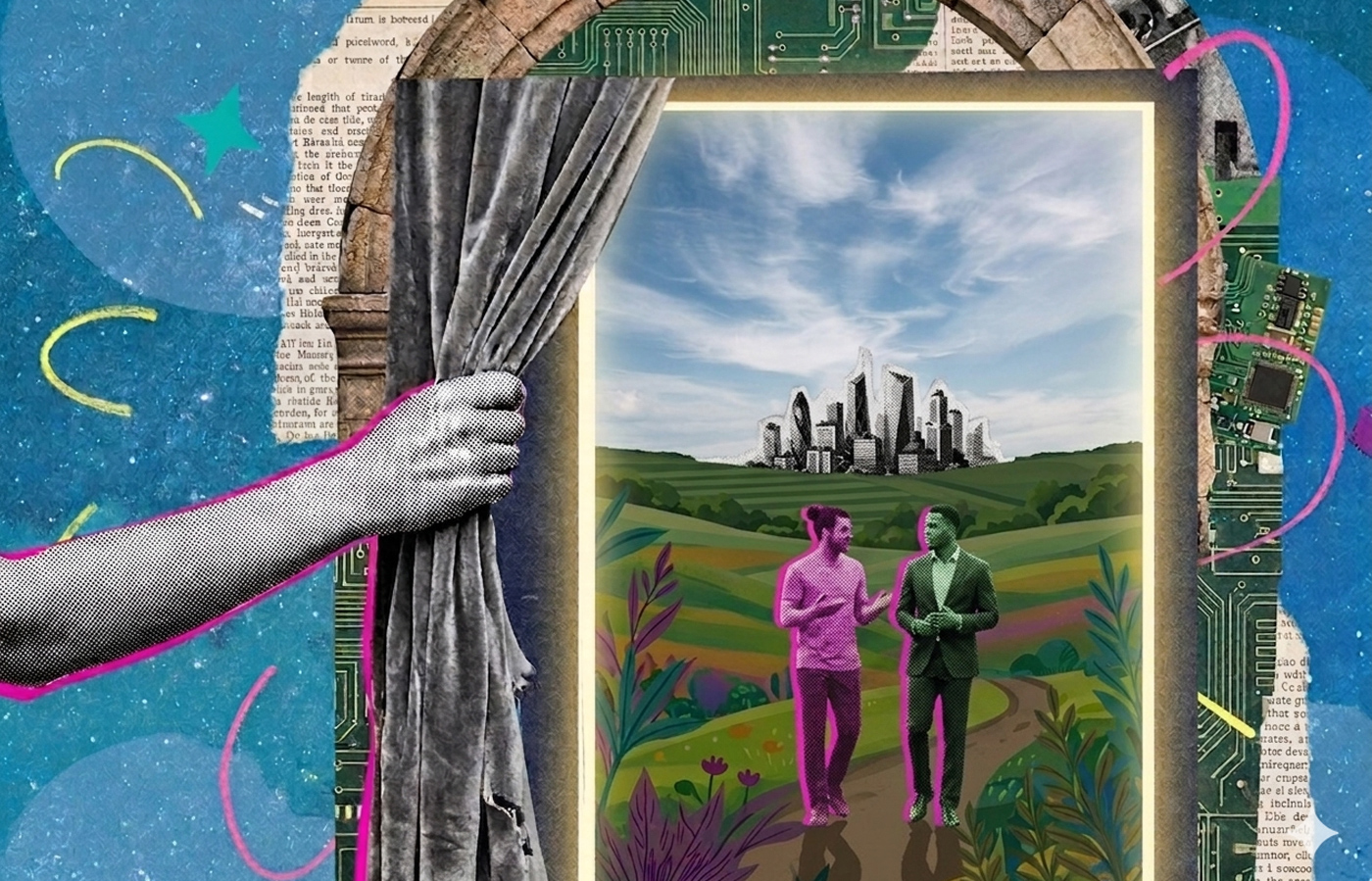
I'm imagining opening up the page of a report. A spread lies before me, and in it is a conversation. A social entrepreneur and an investor are talking together about their approaches to change. There's tension. Some elephants are named. There are photos of them walking and talking. The conversation meanders from the power imbalances in the philanthropy sector to what holds people back from investing. It's not harsh, but it is uncomfortable at times. There's a section that addresses the skeptics head-on: the criticism of social impact and the places it has fallen short. The conversation is honest and engaging.
This is the next level of transparency: real human conversation. People want more of these. In this future, this format is the norm. Different parts of the report open up different questions.
Transparency isn’t liability. After decades of slick marketing materials, from nonprofits to big corporations, AI came on the scene and made it hard for anyone to believe anything anymore. Polish became meaningless.
Real conversations are the ones people crave. This new generation doesn't buy the image. They want reality.
What do you think? I did this on my own, but I know future scenario-ing is better when we do it together.